Photograph the pattern and preserve evidence before scraping, sanding or adding another product.
Garage floor problem guide
Why is my garage floor coating still soft or tacky?
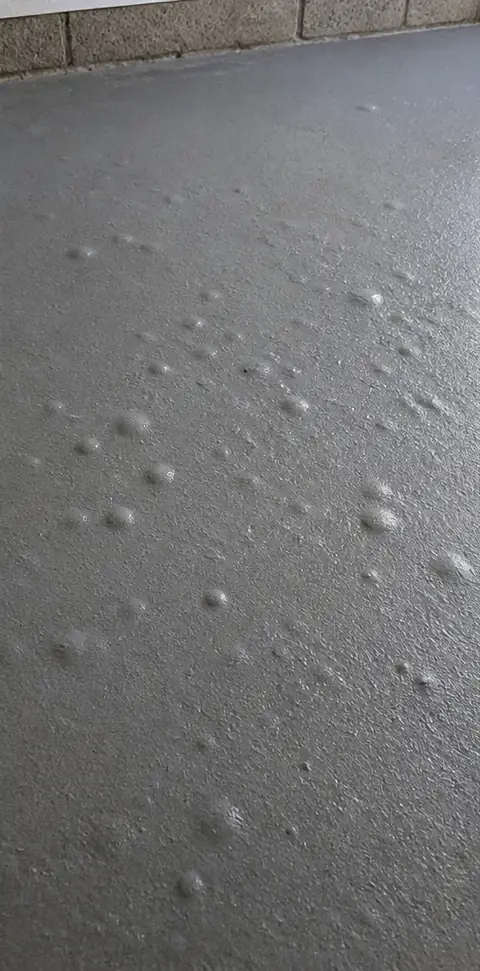
A resin floor that stays soft can involve mix ratio, incomplete mixing, low temperature, contamination, expired material or insufficient cure time. Do not add another coat until the cause and sound boundary are understood.
Restrict traffic, record batch and temperature history, identify soft versus sound areas and follow manufacturer guidance for removal and replacement rather than sealing the defect in.
Install or repair only after the retained substrate and compatible system have been verified.
Before → solution → after
See the problem, the corrective work and the finished floor.
The first frame shows what the homeowner sees now. The center frame shows the preparation or coating work. The final frame shows the finished decorative direction that becomes possible after the substrate is verified.
See the current soft, tacky or uncured coating condition clearly before loose material, residue or other evidence is disturbed.

Restrict traffic, record batch and temperature history, identify soft versus sound areas and follow manufacturer guidance for removal and replacement rather than sealing the defect in.
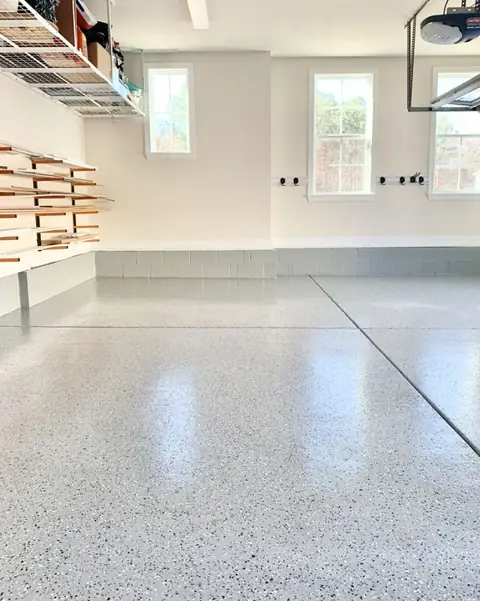
A clean finished floor is installed only after the substrate, repair boundary and compatible layer system are verified.
Educational before–solution–after sequence. Images explain the decision path and are not represented as one completed Texas Garage Floor Coating Installers project.
Immediate answer
What soft, tacky or uncured coating can mean.
A resin floor that stays soft can involve mix ratio, incomplete mixing, low temperature, contamination, expired material or insufficient cure time. Do not add another coat until the cause and sound boundary are understood.
Restrict traffic, record batch and temperature history, identify soft versus sound areas and follow manufacturer guidance for removal and replacement rather than sealing the defect in.
The inspection should identify whether the symptom is cosmetic, a loss of adhesion, weak concrete, active movement, a moisture condition or a cure problem. Those categories change both the repair boundary and whether coating should proceed.
Plausible causes
Six conditions to separate before choosing a fix.
Each card names a real inspection path and the evidence that makes it more or less likely.
Check 01
Incorrect resin-to-hardener ratio
Review the application record, product instructions and the visible boundary before choosing a correction. Map where the condition begins and where it is most severe.
Check 02
Incomplete mixing or unmixed edges
Review the application record, product instructions and the visible boundary before choosing a correction. Compare the affected area with adjacent sound floor and retained layers.
Check 03
Temperature below cure requirements
Compare slab temperature, sunlight, working time, cure history and the actual return-to-use timing. Record when the pattern changes and what the garage was exposed to.
Check 04
Expired or damaged material
Compare slab temperature, sunlight, working time, cure history and the actual return-to-use timing. Review preparation, product history and conditions during installation.
Check 05
Chemical contamination
Map the exposure and cleaning history, then verify whether preparation can reach clean, sound concrete. Check the named manufacturer's limits for this exact layer.
Check 06
Normal cure not yet complete
Compare slab temperature, sunlight, working time, cure history and the actual return-to-use timing. Confirm the sound repair boundary before adding another coating.
Diagnosis route
Four steps from symptom to defined scope.
Map the pattern
Separate tire, random, edge, joint, broad and isolated zones.
Identify the layer
Determine what remains on the concrete and on the failed material.
Check the substrate
Review soundness, contamination, moisture evidence, profile and movement.
Test the boundary
Verify apparently sound areas and document the compatible repair or removal scope.
Finding → next evaluation
The same symptom can lead to different work.
| Finding | Evaluate | Avoid |
|---|---|---|
| Small isolated area | Adjacent adhesion and compatible patch materials | Assuming the visible edge is the whole boundary |
| Broad or repeated pattern | Substrate, moisture, contamination and every retained layer | Covering the pattern with a stronger clear coat |
| Damage at a joint | Expected movement and joint purpose | Rigidly hiding a line designed to move |
| Concrete leaves with coating | Extent of weak or unsound surface material | Using resin to disguise a weak substrate |
Related corrective services
Diagnosis connects to a real installation path.
Epoxy systems
Build, color and decorative versatility over properly prepared concrete.
Open service guide →Full-flake floors
Dense decorative chip coverage with selectable texture and topcoat.
Open service guide →Polyaspartic coatings
Fast-cure topcoat or full-system routes governed by exact product data.
Open service guide →Polyurea coatings
Product-specific fast-cure options without relying on a category label.
Open service guide →Metallic epoxy
Flowing pigments for a custom showpiece garage or finished flex room.
Open service guide →Quartz broadcast
A dense mineral aggregate field with controllable texture.
Open service guide →Soft, Tacky or Uncured Coating FAQ
Six answers before repair or recoating.
Will tacky epoxy eventually harden?
A resin floor that stays soft can involve mix ratio, incomplete mixing, low temperature, contamination, expired material or insufficient cure time. Do not add another coat until the cause and sound boundary are understood. A photograph starts the conversation, but inspection and the installed layer history are needed before one cause is assigned.
Can a topcoat cure the layer below?
Not automatically. Restrict traffic, record batch and temperature history, identify soft versus sound areas and follow manufacturer guidance for removal and replacement rather than sealing the defect in. The surrounding floor must be checked before a localized correction is assumed to be enough.
Why are only some spots soft?
Timing, temperature, moisture, contamination and layer compatibility can create similar symptoms. Record when the condition changes and what the floor has been exposed to.
Is cold weather the cause?
A new topcoat cannot restore a weak or uncured layer below it. The failed interface and sound replacement boundary come first.
Can uncured resin be ground off?
The extent depends on adhesion and soundness beyond the visible defect. A written scope should explain what is retained, removed and why.
What records should the installer provide?
Send one wide garage view, a close-up with scale, joints and thresholds, plus installation date, known products, cleaners, spills and weather or water history.
Slab-first estimate
Document the soft, tacky or uncured coating before covering it.
Send wide and close photographs, the floor history, garage use and ZIP code. The final scope should explain what is retained, removed, repaired or referred.