A sound concrete slab where the specified epoxy system matches use, exposure and moisture condition.
Decorative epoxy garage floor service
Choose a garage floor that looks finished—not merely covered.
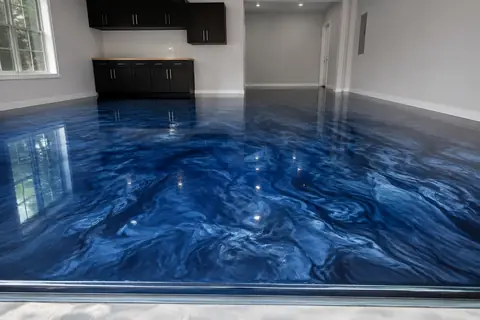
Metallic, full-flake, quartz and solid-color systems can turn bare concrete into a cleaner, brighter room. The finish comes first in the conversation; preparation, moisture, joints and compatible layers are what help it stay beautiful.
Choosing only by color or coat count while substrate and product data remain unspecified.
What must be removed, repaired, tested or preserved before the first resin layer can bond?
Try the finish before the product name
Choose the garage, finish and color you want to compare.
Start with the garage you have, then compare appearance and system routes. This is a visual planning tool—not a price quote or product specification.
Generated previews illustrate design directions. They are not completed company projects, exact color samples, prices or a substitute for inspecting the slab and matching approved products.
Start with the finished room
Eight finish directions—from full-flake to bold solid color.
A show garage and a hard-working garage do not have to use the same finish. Compare metallic, full- or partial-flake, quartz and solid-color appearances before selecting the compatible layer system.
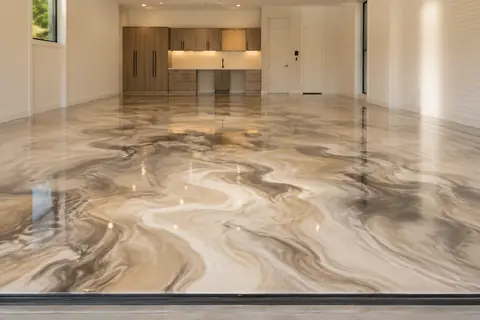
Showpiece finish
Metallic marble
A flowing, one-of-a-kind pattern with dramatic depth for homeowners who want the garage to feel designed—not merely coated.
Request this direction →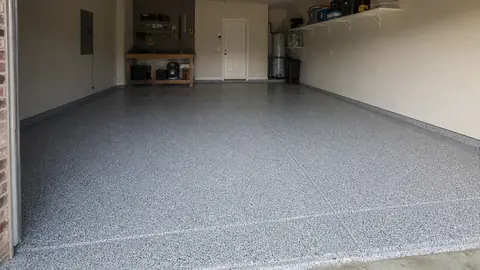
Everyday favorite
Full-flake
A practical decorative field with broad chip coverage, visual texture and many neutral, dark or bold blend directions.
Request this direction →
Bold color direction
Deep blue metallic
A saturated custom look for a garage, home gym or workshop where color is part of the finished room.
Request this direction →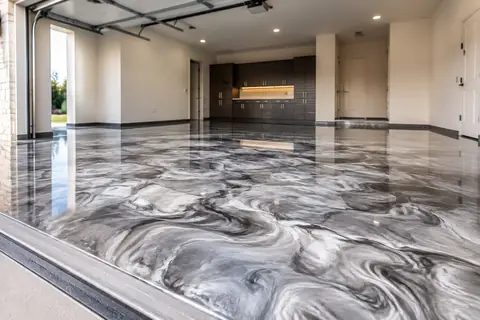
Cool showpiece finish
Silver metallic
A cooler marble-like direction with flowing pigment variation; later scratches and touch-ups can remain more visible than on a busy flake field.
Request this direction →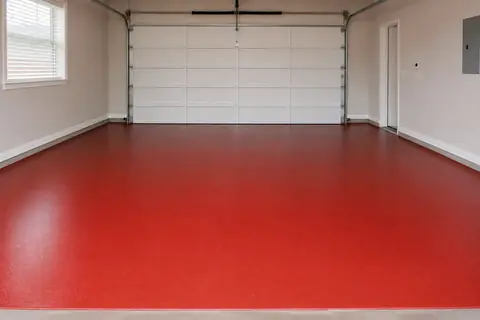
Solid-color finish
Performance red
A uniform saturated color for a bold workshop or collector garage. Even coverage and substrate repair quality stay easy to see.
Request this direction →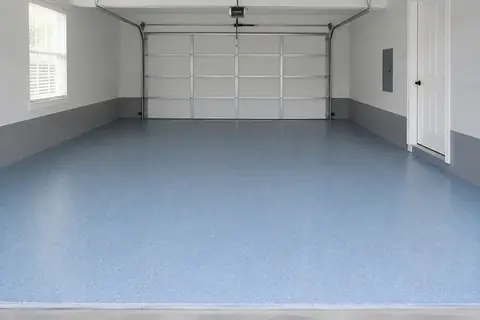
Bright color finish
Sky blue
A lighter, cleaner-looking solid field for a garage, hobby room or home gym, with texture selected around wet use and cleaning.
Request this direction →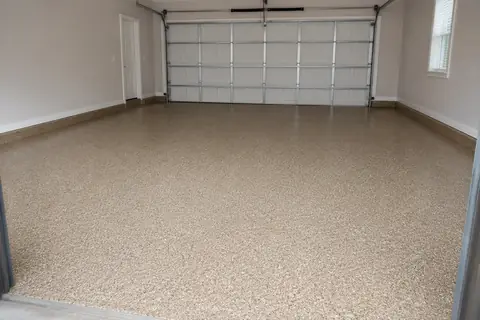
Mineral aggregate
Quartz broadcast
A dense small-grain broadcast with a different texture and visual scale than vinyl flake; approved products and topcoat build must be confirmed.
Request this direction →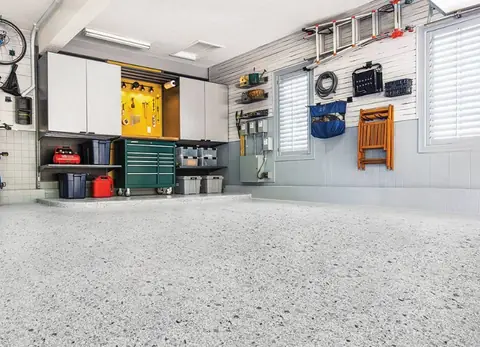
Lighter broadcast
Partial flake
A deliberate scattered-chip look that leaves more base color visible and requires consistent distribution from edge to edge.
Request this direction →Then choose the assembly
Epoxy is one useful component—not the only possible answer.
We compare the finish, traffic, sun, slab and schedule before selecting the base, decorative layer and protective topcoat. Product names are written into the proposal instead of hidden behind a generic “epoxy” label.
Epoxy base and build coats
Epoxy may provide working time, body, color or the binder for metallic pigment and decorative flake. The exact product still has to fit the slab, exposure and protective finish.
Polyaspartic finish or full system
Selected products can provide faster cure plus enhanced UV, abrasion and tire-mark resistance. In Texas heat, their short working window makes product limits and installation timing critical.
Polyurea system options
Polyurea is not one universal formula. Fast-cure base and finish products should be compared by their actual data sheets, preparation, moisture limits and intended garage use.
Urethane-protected finishes
A compatible clear or pigmented urethane topcoat may protect an epoxy color or decorative field. UV, abrasion, tire marking, texture and recoat requirements remain product-specific.
Moisture-mitigation primer
A manufacturer-approved epoxy moisture-control layer may fit some tested slabs. It is not a universal cure for liquid water, drainage problems or readings outside the complete system limits.
Natural concrete alternatives
A penetrating or film-forming sealer and polished concrete create different looks and maintenance profiles from a resin broadcast system. They belong in the comparison when a decorative coating is not the right fit.
Project-specific recommendation
Location and conditions determine the installation plan.
Use + appearance
Daily parking, show garage, workshop, home gym, storage, gloss, color and texture.
Concrete + old layers
New or old slab, sealer, builder residue, cracks, joints, moisture indicators and failing coating.
DFW conditions
Surface and air temperature, humidity, dew point, direct sun, ventilation and whether temperatures are rising.
System + hand-off
Named layers, preparation, texture, cure conditions and separate foot-traffic and vehicle-return times.
Correct / incorrect
The mistake and its likely consequence should be visible immediately.
The new four-panel comparison shows coating placed over a contaminated surface, the peeling that can follow, mechanical preparation and a properly finished system. Detailed wording stays outside the image for accessibility.

What goes wrong
New resin follows the surface it is given
Rolling over contamination, smooth sealer or a failing old layer can leave the entire assembly dependent on a weak interface. The lower image shows the type of peeling that may follow—not a diagnosis of every failure.
Controlled route
Profile sound concrete, then install compatible layers
Mechanical preparation with dust extraction is followed by the product-specific repair, binder, broadcast and topcoat sequence. Joint decisions remain visible instead of being hidden by decoration.
AI-generated educational comparison. It explains workflow logic and is not represented as a completed company project or a universal specification.
Correct installation route
Preparation is part of the floor—not a hidden footnote.
A finished epoxy surface should be the last chapter of the scope. The earlier chapters identify what remains, what is removed, how defects and joints are handled, and which compatible layer performs each job.
- Mechanically prepare to the specified profile.
- Complete compatible repairs without hiding movement.
- Control resin coverage, working time and broadcast.
- Seal, inspect and document the hand-off.

Garage floor coating system
Educational routeRemove weak or foreign material and create the profile required by the named system.
Complete compatible static repairs while keeping control and movement-joint decisions explicit.
Control mix, coverage and working time as flakes are distributed into the receptive resin layer.
Finish with a compatible topcoat, verified texture and product-specific return-to-service guidance.
Generated educational visual. The actual slab, product data and written scope control every step.
Epoxy in ordinary language
“Epoxy floor” describes a family of systems, not one universal product.
Epoxy is created by mixing a resin and hardener. When it cures under the conditions specified by the manufacturer, it forms a bonded resinous layer. In a garage system it may serve as a primer, high-build base coat, pigmented coat, binder for decorative flakes or, with some products, a finish coat.
The useful comparison is not simply epoxy versus another category. It is the written assembly: what remains on the concrete, which layer creates the bond, what provides build and decoration, what protects the surface, and whether all products are compatible.
Technical terms translated
Words that should become concrete scope—not sales jargon.
A weak, fine surface layer on concrete that should not be treated as a strong bonding surface.
The texture created by preparation. Required CSP depends on the coating thickness and manufacturer specification.
Abrasion such as grinding or shot blasting used to remove weak or foreign material and create the required profile.
Moisture moving through the slab that can contribute to loss of adhesion or blistering when the system is unsuitable.
Flakes or aggregate distributed into wet resin. Partial and full broadcast create different coverage and texture.
The product-defined period in which the next layer may be installed without additional preparation.
When epoxy may not be the first choice
A technically honest service page explains the no-install decision too.
Another system, added testing or another qualified professional can be the better next step when the substrate or schedule does not fit.
Moisture or water
Active liquid intrusion or moisture conditions beyond the selected system limits require further diagnosis or a compatible mitigation decision.
Movement or unsound concrete
A moving or displaced crack, heaving slab or weak substrate is not repaired by hiding it beneath resin and flakes.
Exposure and schedule mismatch
Strong UV exposure, return-to-service requirements or unremovable contamination may make the proposed product unsuitable.
Installation route
Diagnose → design → install → hand off.
Diagnose
Record current layers, contamination, defects, joints, moisture indicators, use and exposure.
Design
Select product-compatible profile, repairs, primer/base, broadcast, texture and topcoat.
Install
Control mixing, batch timing, coverage, slab/air/dew-point conditions and recoat windows.
Hand off
Give exact foot/vehicle timing, cleaning guidance, maintenance and verified warranty exclusions.

Broadcast is one step
Decorative material changes finish and texture; it does not replace slab repair, preparation or compatible resin layers.
Photo disclosure
Owner-supplied work-type reference; it is not presented as a completed Texas Garage Floor Coating Installers project.
Compare the written system
Each option starts with a different question.
| Option | Best question to ask | Tradeoff to explain |
|---|---|---|
| Epoxy base + compatible topcoat | Does epoxy provide the required build/bond, and does the topcoat match UV, wear and chemical exposure? | More layers and cure windows; compatibility must be documented. |
| Polyaspartic system or topcoat | Is fast return-to-service or color stability important, and can the crew work within the product's shorter working time? | Faster cure can reduce application margin; slab and weather still matter. |
| Full-flake broadcast | Is visual coverage and a textured decorative finish desired? | Texture, cleaning and slip behavior must be balanced; flakes do not repair concrete. |
| Metallic epoxy | Is a one-of-a-kind decorative look more important than hiding later wear or touch-ups? | Appearance is installer-sensitive; real samples and proof should support the sale. |
| Remove and recoat | Is the old layer weak, incompatible or peeling? | Leaving a weak layer saves preparation time but makes it the bond limit. |
What the quote should name
Scope belongs in writing before installation.
- Measured coated area and included vertical or edge surfaces
- Old coating/sealer removal and contamination treatment
- Preparation method and target profile for the specified system
- Crack, pit, spall and joint treatment, including what may remain visible
- Product names/chemistries, layer sequence, broadcast and texture
- Moisture testing/mitigation policy and exclusions
- Verified recoat, foot-traffic and vehicle-return windows
- Cleanup, care, warranty language and exclusions
Epoxy coating FAQ
Six questions that change the proposal.
Is epoxy the same as garage floor paint?
No. Product labels vary, but a two-component resinous epoxy is chemically different from single-component floor paint. The exact product, solids, preparation and layer build matter more than the marketing name.
Does every epoxy floor yellow in sunlight?
No blanket statement is accurate. Conventional epoxies can discolor under UV, while some products are formulated for improved resistance and many systems use a compatible aliphatic polyurethane or polyaspartic finish. Check the specified data sheets.
Can epoxy be installed over cracks?
Only after the crack or joint is evaluated. Static defects may have compatible repair options; moving joints generally need a movement-compatible detail, and active structural symptoms need the appropriate specialist.
Is diamond grinding always required?
The specified manufacturer defines acceptable preparation and target profile. Abrasive mechanical preparation is common for high-performance resin floors, but the proposal should name the actual method only after the product and substrate are known.
How long before a car can return?
Use the exact product data, temperature and job conditions. A universal one-day, 24-hour or 72-hour promise would be misleading before the system is specified.
Can epoxy go over an existing coating?
Sometimes, but only when the retained coating is identified, compatible, well bonded and prepared within the replacement system requirements. A new coating cannot make a broadly weak old layer sound.
Technical reference frame: ASTM D4259 for abrasive preparation concepts; ASTM F2170 for in-situ concrete relative-humidity testing; and product-specific preparation, joint and data-sheet guidance. Final public claims must match the exact installed products and verified crew practice.
Slab-first estimate
Choose the system after the slab is understood.
Send the current floor, approximate size, ZIP code and photos. The live version will confirm coverage and explain which preparation and product questions belong in the quote.