New homeowners who can document the empty slab, allow the specified preparation and respect product-specific cure before parking.
Dallas–Fort Worth garage floor service
Finish a new-home garage before cars, boxes and storage move in.
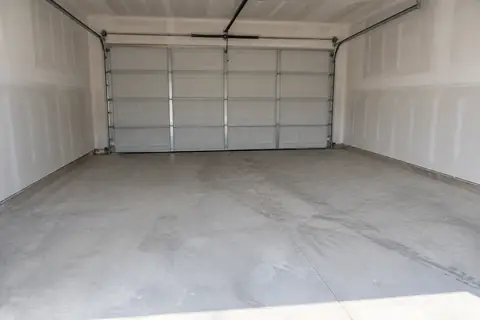
An empty garage is the easiest time to see every joint, edge and builder mark. It is not permission to skip concrete-age, moisture, sealer and surface-profile checks.
Assuming new concrete is clean, dry and ready because it has never been parked on.
Pre-move-in access is convenient, but concrete readiness and full vehicle cure may not match the moving schedule.
Correct / incorrect
The visible finish cannot rescue a weak surface underneath.
Assuming new concrete is clean, dry and ready because it has never been parked on. The controlled alternative begins with sound concrete and one documented compatible assembly.

What goes wrong
New resin follows the surface it is given
Rolling over contamination, smooth sealer or a failing old layer can leave the entire assembly dependent on a weak interface. The lower image shows the type of peeling that may follow—not a diagnosis of every failure.
Controlled route
Profile sound concrete, then install compatible layers
Mechanical preparation with dust extraction is followed by the product-specific repair, binder, broadcast and topcoat sequence. Joint decisions remain visible instead of being hidden by decoration.
AI-generated educational comparison. It explains workflow logic and is not represented as a completed company project or a universal specification.
Four-step installation route
What happens before the garage returns to use.
An empty garage is the easiest time to see every joint, edge and builder mark. It is not permission to skip concrete-age, moisture, sealer and surface-profile checks.
- Inspect the floor and define what remains.
- Prepare to the exact product requirement.
- Control every coat, broadcast and working window.
- State full vehicle cure separately from foot traffic.

Garage floor coating system
Educational routeRemove weak or foreign material and create the profile required by the named system.
Complete compatible static repairs while keeping control and movement-joint decisions explicit.
Control mix, coverage and working time as flakes are distributed into the receptive resin layer.
Finish with a compatible topcoat, verified texture and product-specific return-to-service guidance.
Generated educational visual. The actual slab, product data and written scope control every step.
Layer-system technology
New-Home Garage Floor Coatings belongs in a complete written assembly.
The diagram is intentionally chemistry-neutral until approved products are named. It prevents a color or material label from standing in for substrate preparation and compatibility.
Compatible topcoatWear, color stability, chemical exposure, sheen and texture selected for actual garage use
Decorative broadcast or finishSpecified coverage and texture—never a substitute for preparation or repairs
Primer / binder / baseExact product chemistry, coverage, mix ratio and recoat window documented as one assembly
Prepared concrete profile + repairsSound, clean surface with defects classified and treated by compatible methods
Movement-joint detailDo not erase expected slab movement with a rigid decorative layer.
Existing concrete slabSoundness, moisture condition, past sealers/coatings and exposure evaluated first
Educational cross-section only. The selected manufacturer's data sheets and the condition of the actual slab control the final sequence, thickness, preparation and cure.
Project route
Diagnose → design → install → hand off.
Inspect and document
Identify existing layers, contamination, defects, joints, moisture indicators, light and how the garage will use the new-home garage floors finish.
Prepare and repair
Remove weak or foreign material, create the manufacturer-required profile and complete only compatible repairs while preserving movement decisions.
Install the named assembly
Control mix, coverage, working time and recoat windows for the primer, base, decorative layer and finish used in the new-home garage floor coatings scope.
Verify and hand off
Inspect appearance and texture, then provide product-specific foot traffic, vehicle return, cleaning and maintenance guidance.
When another route may fit
Compare before committing to one material name.
Delay installation until the slab and schedule fit the system, while keeping tire dressing, oil and storage off the future coating area.
A useful proposal explains why the selected route fits the floor, use, exposure and schedule—and also names any condition that would stop or change installation.
Compare complete coating systems →New-home garage floors FAQ
Six questions before the system is approved.
How soon after concrete is poured can it be coated?
The answer comes from the selected product, slab testing and construction details. A generic calendar rule is not enough.
Why would a new slab need grinding?
New concrete can have weak laitance, a smooth finish, curing material or contaminants. Preparation creates the profile required by the system.
Should the floor be coated before move-in?
It can simplify access if the concrete is ready and the move respects full cure. Coordinate storage and vehicle timing in writing.
What builder information is useful?
Pour date, curing method, sealer or densifier, previous cleaning and repair history all help.
Do new-slab cracks mean the coating cannot be installed?
Not automatically. Cracks and joints must be classified; movement or structural symptoms need a different response.
Which finish is popular for new garages?
Full-flake is a practical comparison, while metallic and solid-color floors suit showpiece goals. The right choice depends on use and taste.
Related service paths
Compare the finish and repair routes around this service.
Epoxy systems
Build, color and decorative versatility over properly prepared concrete.
Open service guide →Full-flake floors
Dense decorative chip coverage with selectable texture and topcoat.
Open service guide →Polyaspartic coatings
Fast-cure topcoat or full-system routes governed by exact product data.
Open service guide →Polyurea coatings
Product-specific fast-cure options without relying on a category label.
Open service guide →Metallic epoxy
Flowing pigments for a custom showpiece garage or finished flex room.
Open service guide →Quartz broadcast
A dense mineral aggregate field with controllable texture.
Open service guide →Slab-first estimate
Ask whether new-home garage floors fits this exact garage.
Send a wide floor photo, close-ups, garage size, planned use, ZIP code and preferred appearance. The final scope should identify every approved product and condition.